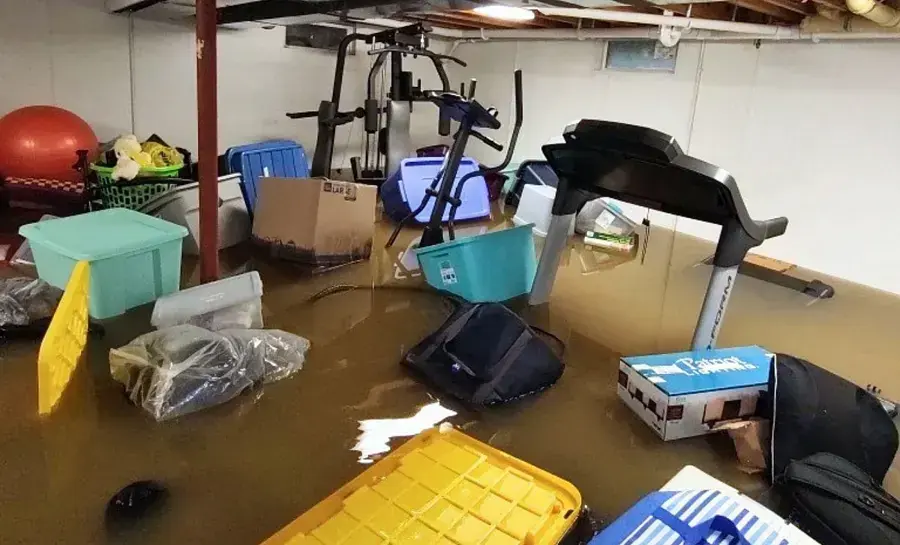
In an older Hempstead house, water rarely comes through the front door. It slips in through the places built to move air, light and runoff: window wells, stairwell drains and floor drains.
Key takeaways
- Window wells, stairwell drains and floor drains are the three usual ways heavy rain reaches a Hempstead basement.
- Much of the village housing went up before 1960, and many of those homes sit on full basements.
- The remnants of Hurricane Ida in September 2021 flooded basements across Nassau County through exactly these openings.
- Water that comes up through a floor drain tied to the sewer is treated as contaminated, not as clean rain.
- Pumping out the water is only the first step; walls, floors and framing still need to be dried and read with a meter.
Why older Hempstead homes take on water this way
Hempstead is one of the oldest settlements on Long Island. A large share of its housing was built before 1960, including two family homes, Colonials, Capes and Tudors, plus apartment buildings downtown.
Many of those houses sit on full basements, and the lowest level is where the rain ends up when the yard, the street and the drains can no longer keep pace.
The village also sits on the Hempstead Plains outwash, with Hempstead Lake and the Mill River to the southwest. Weather here comes as nor'easters, summer cloudbursts, tropical remnants and winter cold snaps, so the basement gets tested more than once a year.
The three usual entry points
When a basement floods after a storm, the water almost always has a specific way in. Finding it matters, because it decides how the cleanup is handled.
Window wells
A window well is a small pit around a basement window. In a cloudburst it fills faster than the ground around it can drain.
Once the water reaches the sill, it pushes past the frame and runs down the wall onto the floor.
- Leaves and debris in the well slow drainage.
- Water often shows up first along the wall under the window.
- A wet carpet edge near a window is a clue worth checking.
Drains at the bottom of exterior stairs
Homes with an exterior basement stairwell have a drain at the bottom to carry away rain. When that drain clogs or the sewer behind it is full, the stairwell turns into a basin.
The water then rises against the basement door and moves under it.
Floor drains tied to the sewer
Many Hempstead basements have a floor drain tied to the sewer. When the system is overloaded, the flow can reverse and push water up through that drain.
That is a different problem from rain through a window. It is a sewage backup, and it is handled as a contaminated loss.
What Ida showed across Nassau County
The remnants of Hurricane Ida in September 2021 flooded basements across Nassau County. The water got in through window wells, stairwell drains and floor drains, the same openings that older Hempstead homes have.
That storm is a useful reminder rather than a prediction. A basement does not need a hurricane to flood; a short, heavy cloudburst can do it.
Hurricane Sandy in October 2012 brought a different problem to the area: wind damage and multi day outages inland. Power outages matter in a basement because any pump that depends on electricity stops when the power does.
The first day: what helps and what does not
The first hours after a basement floods set the course for everything that follows. A few simple choices protect people and limit the damage.
- Stay off the stairs and out of the water until the electrical panel and outlets are known to be safe.
- Shut off power to the basement at the panel only if the panel is dry and reachable without stepping into water.
- Photograph how high the water reached on the walls and the stored items before anything is moved.
- Move boxes, rugs and furniture up off the floor onto blocks or higher surfaces.
- Call the restoration team early, before wood trim and drywall wick the water upward.
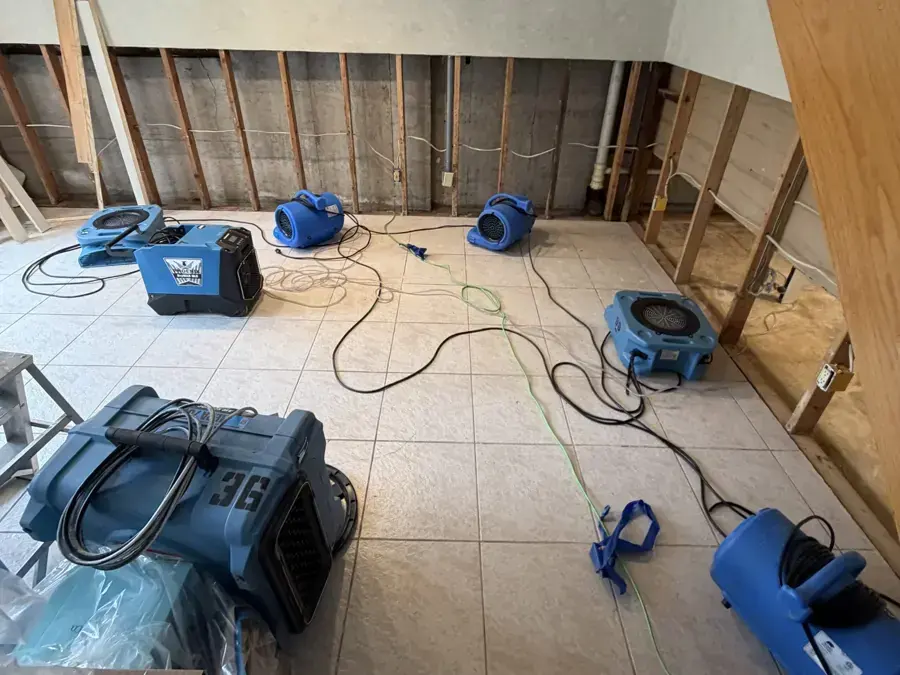
What the extraction crew does first
The first job is to get the standing water out. Truck mounted extraction and pumps remove it, and the crew checks where the water came from while it drains.
Then the work shifts from water that can be seen to water that cannot. Carpet, pad and the bottom of the drywall absorb moisture and pass it along.
Contents are sorted at the same time. Items stored on the floor of a basement, such as boxes, holiday decorations and old furniture, are often the first casualties, and the crew helps owners decide what can be saved.
- Pump out the standing water and extract what has soaked into carpet and pad.
- Decide whether the water is clean rain, storm water or sewage, since that sets what must be removed.
- Open wall bottoms and make flood cuts where the meter shows moisture behind the surface.
- Set air movers and dehumidifiers and log daily readings until the structure reaches its dry standard.
- Sort stored contents into salvageable and not.
Why drying takes longer than pumping
Pumping a basement can be done in a day. Drying the concrete, block, framing and plaster takes much longer, because older materials hold water.
Leaving damp walls closed up invites mold, which can begin within 24 to 48 hours. The drying team uses meters, not guesswork, to decide when the equipment can leave.
The structural drying service covers that second stage, and the drying time estimator gives a rough sense of how long a loss like this can take.
Reducing the odds next time
No household can control a nor'easter, but a few habits make basement water less likely to turn into a large loss.
Neighbors in two family homes and downtown apartment buildings can also compare notes. A drain that backs up in one unit often does so in the next.
- Clear leaves from window wells and the stairwell drain before storm season.
- Keep valuables and paper records off the basement floor.
- Ask a plumber whether a backflow device suits the floor drain in a home with a history of backups.
- Know where the main water shutoff and the electrical panel are before the next forecast.
Questions
Is basement flooding in Hempstead covered by homeowners insurance?
It depends on the policy and the cause. Many standard policies treat sewer backup and surface water differently, so the policy language matters. The restoration team documents the loss so an insurer has what it needs.
How can a homeowner tell if the water came from a floor drain or a window well?
Look at where the water first appeared. Water along a wall under a window points to the well. Water bubbling up at the drain, often with a foul smell, points to the sewer, and that water should be treated as contaminated.
Is a wet vacuum enough for a flooded basement?
A household wet vacuum handles a small spill. A flooded basement needs pumps and extraction, and sewage water should not be handled with household tools at all.
Does clean rain stay clean once it is in a basement?
Not for long. Storm water picks up soil and debris on the way in and sits against porous materials. That is why storm flooding is treated as contaminated, with wall bottoms and pad removed.
What does Hempstead basement flooding cleanup involve?
Extraction, assessment of the water source, removal of materials that cannot be dried, then drying with air movers and dehumidifiers. The basement flooding cleanup service follows those steps, and storm and flash flood cleanup covers heavy rain events.