Structural Drying and Dehumidification in Hempstead, NY
Structural drying means framing, subfloor, plaster and concrete, not just surfaces. The drying team sizes air movers and dehumidifiers to the class of loss and runs them until readings reach the IICRC S500 goal.
(888) 527-9860Need the drying done right? Call now.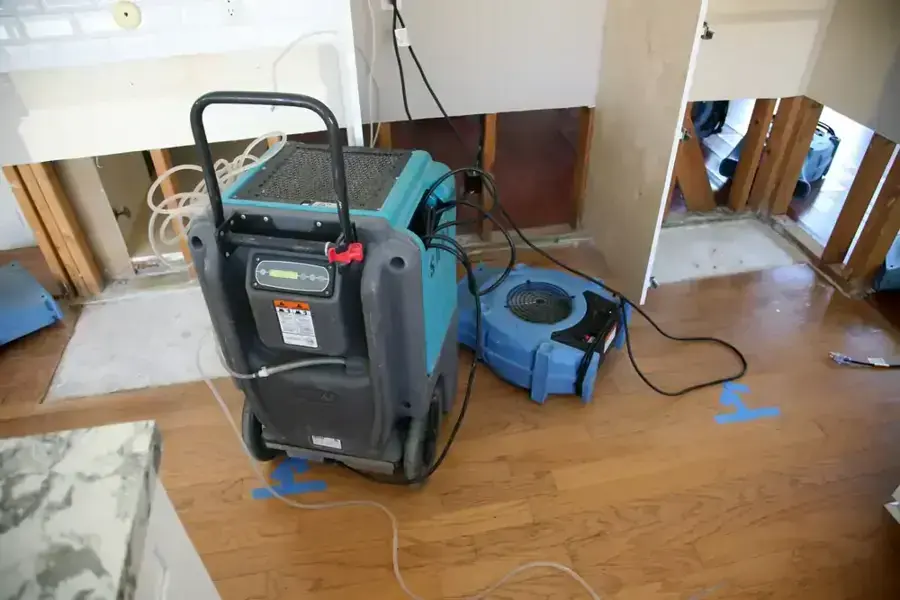
First steps for structural drying and dehumidification in Hempstead
Keep the equipment running
Air movers and dehumidifiers work around the clock.
Keep doors and windows shut
Closed rooms let dehumidifiers do their job.
Keep the heat steady
Warm air speeds evaporation in most seasons.
Leave the readings to the crew
Do not move equipment between daily visits.
Surfaces dry in a day. Framing, subfloor, plaster and block do not. Structural drying is the part of a water job that decides whether the house is actually dry when the equipment leaves, and the drying team measures it every day.
What does structural drying and dehumidification cost in Hempstead, NY?
In Hempstead, NY, structural drying typically runs $1,500 to $16,000, depending on the class of loss, the number of rooms, dense materials like plaster and hardwood and how many days of equipment it takes.
| Scope | Typical range | Usually includes |
|---|---|---|
| One room, Class 1 or 2 | $1,500 to $3,500 |
|
| Several rooms, Class 3 | $3,500 to $8,000 |
|
| Class 4: plaster, hardwood, block | $8,000 to $16,000 |
|
Ranges are typical, not a quote: category of water, square footage, material class and how fast drying started move the number most. Run the Hempstead water damage cost calculator for a closer range.
How structural drying and dehumidification is handled in Hempstead
The tech who does the walkthrough maps moisture before any equipment goes down, so the drying plan matches what is actually wet. Equipment stays until the readings say dry, not until it looks dry.
- I
Map
Meters and thermal imaging set the wet area and class of loss.
- II
Set
Air movers and dehumidifiers sized to the evaporation load.
- III
Monitor
Daily readings and a psychrometric log for every room.
- IV
Verify
Equipment leaves when materials match the dry reference.
How drying is planned
The tech who does the walkthrough maps the wet materials with pinless meters and thermal imaging, then sets the class of loss under the IICRC S500 standard. Class 1 is a little water on low-porosity materials; Class 4 means dense materials like plaster, hardwood and concrete that need special drying.
- Air movers are placed to the room's evaporation load, not a fixed count.
- LGR dehumidifiers pull water from the air in most rooms.
- Desiccant dehumidifiers handle block, slabs and cold basements.
- Cavity and hardwood mat systems push dry air where fans cannot reach.
Older Hempstead homes dry differently
Plaster on lath, old-growth hardwood and block foundations are common in the village, and all three hold water longer than modern drywall and plywood. The drying team checks a dry reference material in the same house and keeps going until wet materials read within 2 to 4 points of it. Daily temperature, humidity and grains-per-pound readings go into a psychrometric log for the claim file. Removal decisions for contaminated water follow the sewage backup cleanup protocol.
- Equipment stays until the readings say dry, not until it looks dry.
- Closed rooms and steady heat speed the drying.
- Drying logs show the adjuster the job was done to standard.
Why readings matter
Materials put back while still wet can warp, stain and smell. The EPA indoor air quality pages explain why moisture control matters indoors, and Energy Saver covers humidity control at home. Try the drying time estimator for a typical window.
Structural drying and dehumidification across Hempstead and nearby Nassau County
The Hempstead restoration crew covers ZIP 11549, 11550 and 11551, from Downtown Hempstead and the transit center out to Kennedy Memorial Park, the Hofstra University area, Peninsula Boulevard and the side streets off Fulton Avenue.
Nearby coverage reaches Garden City, West Hempstead, Uniondale, Roosevelt, Rockville Centre, Malverne, Mineola, Baldwin, Freeport, East Meadow, Williston Park, Town of North Hempstead.
Related water damage services in Hempstead
Structural Drying and Dehumidification questions in Hempstead, NY
What does structural drying mean?
Drying the structure itself: framing, subfloor, plaster, hardwood and concrete, not just the surfaces you can touch.
How is dry measured?
Wet materials are compared with a dry reference material in the same house. The IICRC S500 goal is within 2 to 4 points of that reference.
Why so many air movers?
Air movers are sized to the evaporation load of the room. Fewer units mean slower drying and more risk of damage.
What is the difference between LGR and desiccant dehumidifiers?
LGR units cool air to condense water and suit most rooms. Desiccant units use a drying wheel and work better on dense materials and in cold spaces.
Can I turn the equipment off at night?
No. Turning it off lets humidity climb and adds days to the drying.
Why does plaster take longer than drywall?
Plaster on lath is dense and thick, so it holds water longer and releases it slowly.
Will the drying records help my claim?
Yes. Daily readings and psychrometric logs show the adjuster what was wet and how it was dried.
Water damage in Hempstead? Get the drying started today.
Structural drying is measured, not guessed. The drying team logs readings every day until the numbers say dry.
(888) 527-9860Hempstead structural drying, 24/7