A flooded storefront loses money every day the doors stay shut. The first day after the water arrives sets how quickly an owner can open again, and the order of steps matters more than speed alone.
Key takeaways
- In late September 2023, an estimated nine inches of rain fell in about six hours and flooded streets across Rockville Centre.
- The storm damaged the Backyard Players storefront on Long Beach Road and the basement of the John A. Anderson Recreation Center.
- Water that drains away with the rain still leaves moisture in floors, walls and stock.
- Street flood water is contaminated, so affected materials are handled that way.
- Photos, an inventory list and early contact with the insurer protect a claim.
What the September 2023 storm did
Late in September 2023, an estimated nine inches of rain fell in about six hours. It was one of the heaviest September rainstorms on record.
Parts of Long Beach Road, Hempstead Avenue, Lakeview Avenue and Peninsula Boulevard were knee deep in floodwater. Water rose past the sidewalk on Hempstead Avenue at Birch Lane.
Public Works, fire and police departments rescued drivers who were trapped in high water.
Who was hit
The flood damaged the basement of the John A. Anderson Recreation Center and the Backyard Players storefront on Long Beach Road.
One is a public building and the other is a small business. Both are the kind of space where water reaches stock, equipment, records and floors all at once.
The water drained away as soon as the rain stopped that night, and roads and shops returned to normal. That quick recovery on the surface can hide what stayed behind in carpet, wall bottoms and the lower part of fixtures.
Why a storefront loss is different
A home can wait a day. A business usually cannot, because lost sales, perishable stock and staff schedules all depend on the doors being open.
That changes the plan from a simple cleanup to a staged one.
Tenants have an added layer. The landlord owns the building, the tenant owns the stock and fixtures, and each has its own insurance.
Telling both early avoids delays later.
Signage, point of sale systems and display cases are easy to overlook in the first rush. They are often the most expensive items on the floor, and they sit closest to the ground.
- Stock and fixtures have to be moved, sorted and sometimes discarded.
- Electronics, registers and refrigeration need to be checked before they are powered up.
- A landlord, a tenant and two insurers may all have a stake in the loss.
- A reopening date depends on drying readings, not on how the floor looks.
The first day, step by step
The first day is mostly about safety, documentation and getting the water out.
Make it safe
Stay out of standing water near outlets, panels and equipment. Shut off power to the flooded area only if the panel is dry and reachable.
Street flood water carries soil, debris and whatever the storm drains pushed back up, so it is not safe to handle with bare hands.
Document before anything moves
Take wide photos of the room, then close ones of the stock, equipment and the height the water reached on walls and fixtures.
Start a written list of damaged inventory with quantities and values. An insurer will ask for it.
- Photograph before moving anything.
- Keep damaged items until the adjuster has seen them, unless they are a hazard.
- Save receipts for any emergency purchases.
Call the response team early
The earlier extraction begins, the less water soaks into the floor and the bottom of the walls. The restoration team can start while the owner is still gathering paperwork.
Protect stock and records
Lift paper records, boxed stock and electronics onto shelves or tables above the water. Cardboard and paper wick moisture up in a short time and are hard to save.
- Move records and paperwork to a dry room.
- Unplug electronics rather than switching them on.
- Keep a running list of what was moved and where.
How a commercial cleanup is run
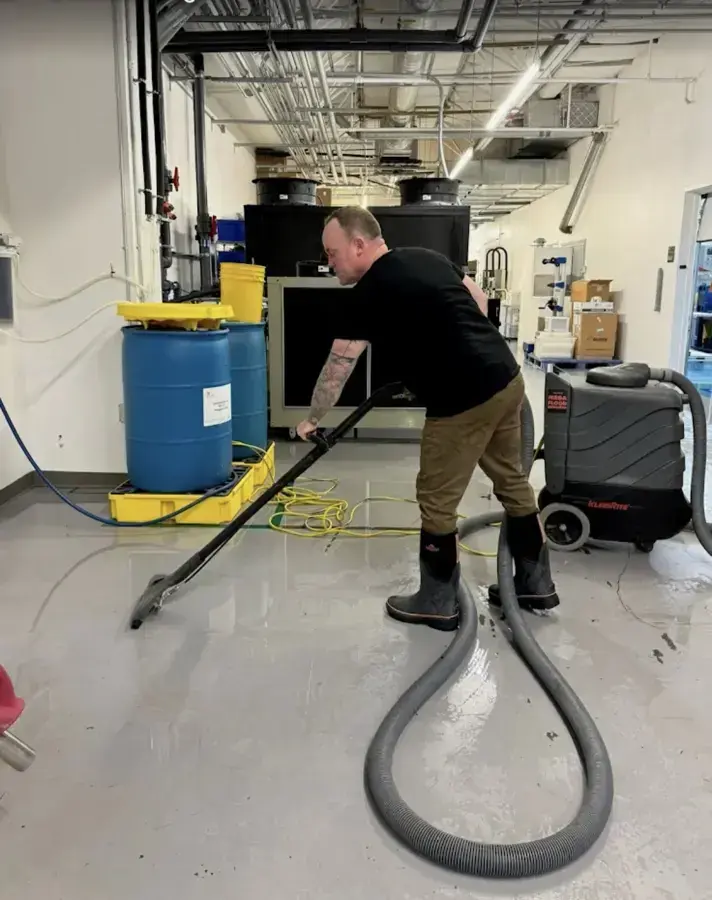
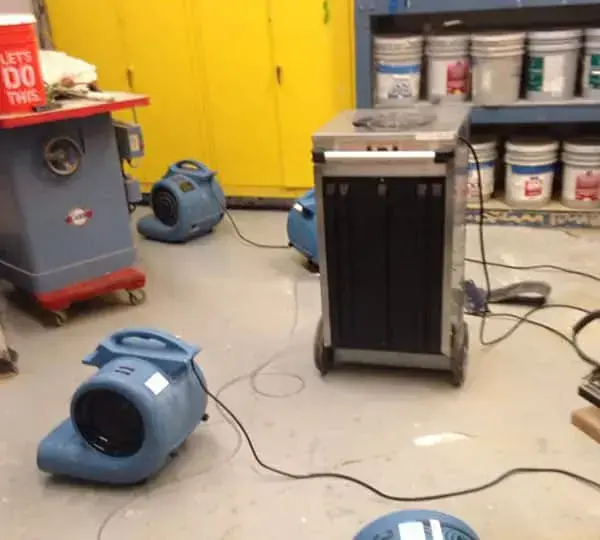
The extraction crew removes standing water first. Then the drying team maps moisture in floors, walls and ceilings and sets equipment to match.
In a shop, that often means working in phases so one area can reopen while another is still being dried.
Work can be scheduled after hours when a shop needs to stay open during the day. That takes planning, because equipment in a customer area has to be safe and quiet enough to stay in place.
The crew also sorts contents. Items that can be dried or cleaned are set aside, and anything that cannot is listed for the insurer before it is thrown out.
- Extract standing water and soaked floor coverings.
- Remove porous materials that touched flood water, such as carpet tile, pad and the lower part of drywall.
- Clean and treat hard surfaces.
- Set air movers and dehumidifiers and take daily readings.
- Move to the next phase only when the meter says the last one is dry.
Public buildings and lower levels
A recreation center basement, a storage room under a shop or a stockroom below street level collects water from every direction. Those spaces need pumps first, then drying.
The mayor said at the time that the village had made many infrastructure improvements, but that storm drains can only carry so much water before they overflow. That is a fair description of a short, intense rain: some water has nowhere to go but into the lowest spaces.
Flooding on Sunrise Highway on August 3, 2026, after up to 3 inches of rain, was a smaller event that showed the same pattern.
Getting back to business
Reopening depends on readings, a safe electrical system and a clean, dry floor. The commercial water damage service covers the full process for shops, offices and public buildings.
For a flood from heavy rain, the storm and flash flood cleanup service explains how contaminated storm water is handled. The Rockville Centre hub lists the other services available in the village.
A realistic reopening plan has three parts: the water is out, the structure is dry, and the electrical and refrigeration systems have been checked. Skipping any one of them risks a second loss.
Customers and staff also need to hear what is happening. A short sign on the door and a message on the shop website are enough to keep goodwill while the work goes on.
Questions
How soon should a business call after a flood?
As soon as the area is safe. Water that sits in carpet, pad and wall bottoms spreads and makes the loss larger.
Does a flooded shop have to close?
Not always. Phased drying can keep part of a space usable while another part is worked on, depending on the damage and on safety.
Is street flood water clean?
No. It carries soil and debris and is handled as contaminated, so affected porous materials are removed.
What should be documented for the insurer?
Photos before anything is moved, a list of damaged stock and equipment, receipts, and the date and time the water arrived.
Why does a dry looking floor still need drying?
Moisture stays in concrete, wall bottoms and framing after the surface looks fine. A meter shows what the eye cannot.