In a village where about one in five homes is rented and houses sit close together, a leak rarely stays in the unit where it starts. It shows up first as a stain on a neighbor's ceiling.
Key takeaways
- About 79.2 percent of Williston Park housing units are owner occupied, so roughly one in five homes is rented.
- The village is in the Town of North Hempstead, not the Town of Hempstead.
- A leak from above usually shows first as a ceiling stain, then as dripping or sagging.
- Shutting off the water in the unit above is the first move, and the unit below needs extraction and drying.
- Who pays depends on the lease, the cause and the insurance, so document everything.
A village of close neighbors
Williston Park is an incorporated village in the Town of North Hempstead. It is not in the Town of Hempstead.
The village counted 2,787 housing units in 2020, and it began in the 1920s as a planned suburb. About 79.2 percent of housing units are owner occupied, so roughly one in five homes is rented.
Homes sit close together, and there are apartments as well. A leak above is a common way for one household to affect another.
The village has also had a public discussion about a rental townhome proposal on Syracuse Street. At a Village Hall hearing in October 2025, about two dozen speakers raised concerns including unit count, garbage, traffic and water usage.
Whatever comes of that proposal, it shows how close living and shared utilities are already on residents' minds.
- Water above a ceiling can come from a bath, a kitchen, a washer or a heating pipe.
- Shared walls let water move sideways as well as down.
- A small leak that runs unnoticed for a week is often worse than a burst that is caught at once.
How a leak from above reaches the ceiling below
Water from a bath, a supply pipe or an appliance upstairs follows the path of least resistance. It soaks the floor, drops into the cavity between floors and travels along the joists.
By the time a stain appears on the ceiling below, the water has often been moving for a while.
- A brown or yellow stain that grows is a sign of active water.
- Paint that bubbles or peels points to moisture behind it.
- A ceiling that sags or bulges is holding water and can fail.
- Drips from a light fixture mean water is near wiring.
What to do right away
A leak from above is urgent for both households, and each has a different role.
Neither household should try to patch a leak or open a ceiling alone. The water above the plaster can be heavy, and a ceiling can drop without warning.
In the unit below
Keep people and furniture away from the stained area, and stay clear of fixtures that are dripping. Place a bucket under any drip.
Turn off power to a room only if the panel is dry and can be reached safely.
- Photograph the ceiling and anything damaged.
- Move furniture and belongings away from the wet area.
- Tell the landlord or building manager and the neighbor above.
In the unit above
Shut off the water to the fixture or the whole unit. Stop using the bath or appliance that may be leaking.
How a ceiling is opened and dried
A wet ceiling is heavy. Water can pool above drywall or plaster, and a ceiling that looks intact can give way.
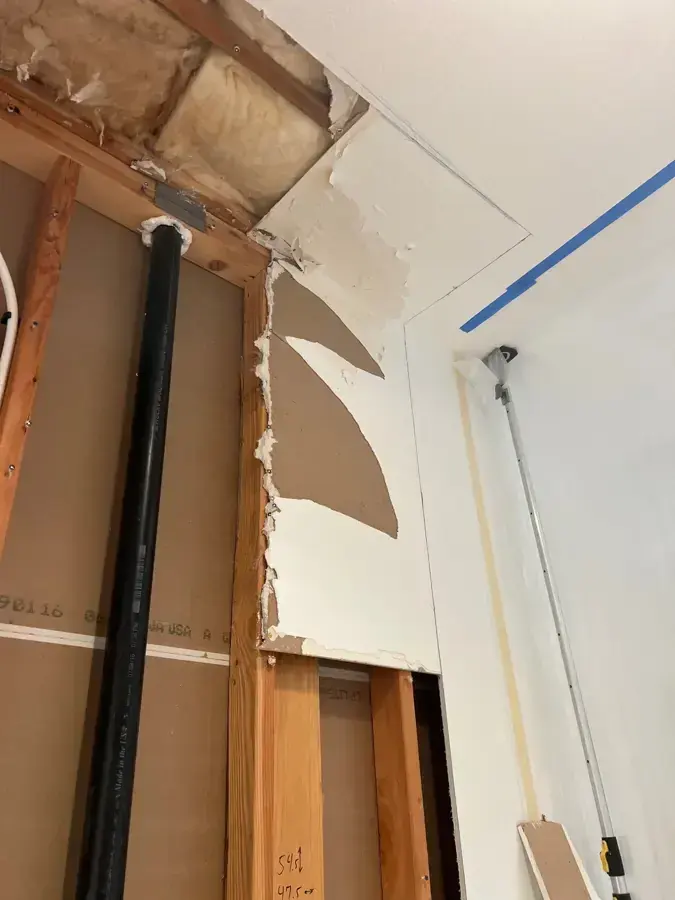
Rather than waiting for it to fall, the crew opens it safely, drains the trapped water and removes what cannot be dried.
Plaster ceilings need extra care. They are heavier than drywall and break in larger pieces, so a controlled opening protects people and furniture below.
After the opening, the crew checks the floor above too. A leak that started in a bathroom upstairs often leaves the subfloor and the cabinet base wet.
- Map the leak with meters and a thermal camera.
- Make a controlled opening to drain trapped water.
- Remove wet insulation and drywall or plaster.
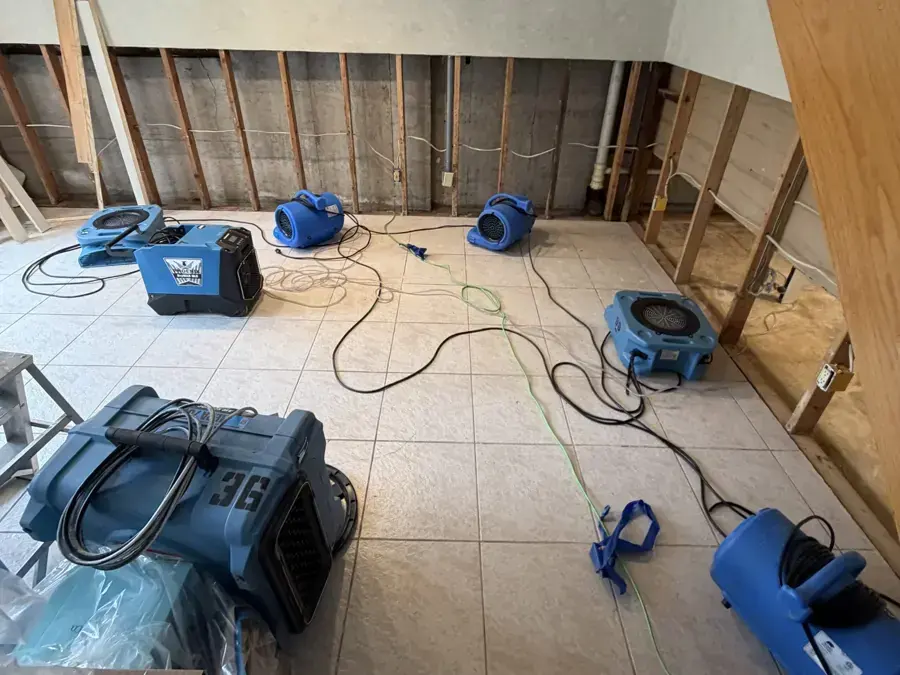
- Dry the joist bays and the floor above with air movers and dehumidifiers.
- Check readings daily until the cavity is dry.
Drying older framing fully
Williston Park began as a planned suburb in the 1920s, so the framing in many homes is old. Older framing has to be dried fully, so moisture does not stay in walls and floors.
Wood and plaster hold water longer than they appear to. The structural drying service uses readings to confirm the job is done, and the ceiling leak water damage service handles the opening and cleanup.
Close lots and shared walls also mean a leak can cross from one home to the next. The drying team checks the walls beside and below the visible damage, not only the stain.
That wider check is often what separates a job that is finished from one that comes back as a musty smell a month later.
Who is responsible, and who pays
A leak between units raises questions about responsibility. The answers depend on the lease, the cause of the leak and the insurance policies involved.
Neither household needs to settle that on the first day. What matters first is stopping the water and documenting the damage.
Landlords of small buildings can help by posting who to call and keeping the water shutoff for each unit easy to find. Tenants help by reporting a drip before it becomes a stain.
- Photograph everything before it is moved or repaired.
- Keep a written record of when the leak was noticed and who was told.
- Save receipts and the plumber's report.
- Tell each insurer early.
Repairs and permits in the village
Building and plumbing permits go through the village Building Department. The village code requires a master plumber to be on file before plumbing work starts.
That matters if the leak came from a failed pipe or fixture that needs replacing. The restoration crew dries the structure, and a plumber handles the repair.
The Williston Park hub lists the other services available in the village.
Village Hall, the Building Department and the Water Department are on Willis Avenue. The Water Department sends after hours emergencies to emergency dispatch rather than the office.
Questions
Is Williston Park in the Town of Hempstead?
No. It is in the Town of North Hempstead.
How can a tenant tell if a ceiling is about to fail?
A sagging, bulging or dripping ceiling is holding water. Keep people out of the area and have it opened safely.
Who has to deal with the leak, the tenant or the landlord?
That depends on the lease and the cause. Both should report it promptly and document the damage.
Can a wet ceiling be dried without opening it?
Sometimes, but trapped water often needs a controlled opening. A meter shows what is needed.
Why does drying take several days?
Wood framing, plaster and insulation hold moisture. Equipment runs until readings reach the dry standard.