Structural Drying in Mineola, NY
After the water is out, the real work in a Mineola home is drying what is left: framing, subfloor, plaster and hardwood, using controlled airflow and dehumidification measured against a dry standard.
(888) 527-9860Request drying equipment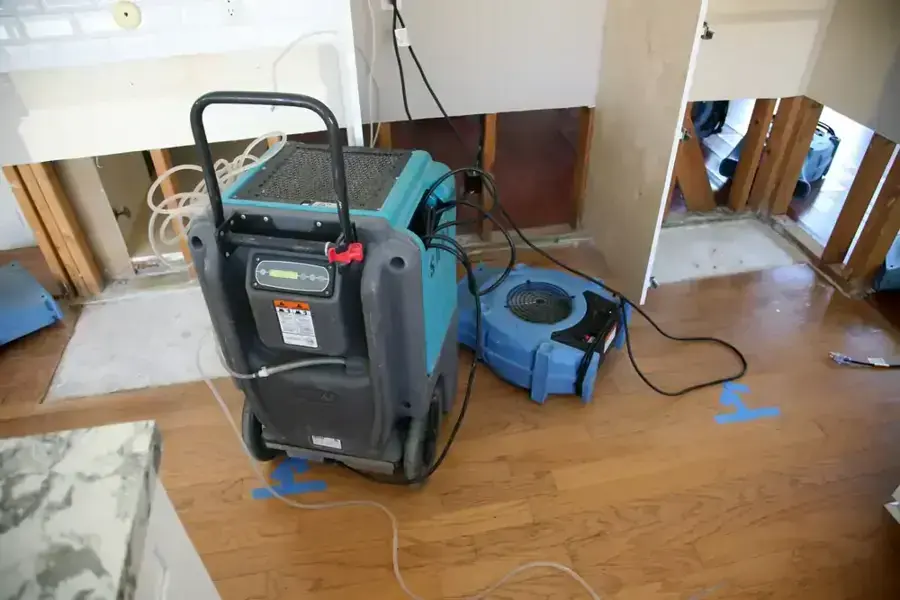
First steps for structural drying and dehumidification in Mineola
Leave equipment running
Once equipment is set, keep it plugged in and unmoved.
Keep doors closed
Closed doors in the drying zone help the dehumidifiers work.
Skip the heat
Do not run extra heaters or open windows in humid weather.
Keep the readings
Save the daily logs the crew leaves for the claim.
Drying is a measured process, not a matter of leaving fans on. The target is the moisture content of each material, and the equipment stays only as long as the numbers say it should. Equipment placed by guesswork wastes days. The Mineola drying team sets targets before equipment goes in.
What does structural drying and dehumidification cost in Mineola, NY?
Drying one room at Class 1 or 2 runs about $1,500 to $3,500, several Class 3 rooms $3,500 to $8,000, and Class 4 plaster, hardwood or block work $8,000 to $16,000.
| Scope | Typical range | Usually includes |
|---|---|---|
| A single room at Class 1 or 2 | $1,500 to $3,500 |
|
| Several rooms at Class 3 | $3,500 to $8,000 |
|
| Class 4 plaster, hardwood or block | $8,000 to $16,000 |
|
Ranges are typical, not a quote: category of water, square footage, material class and how fast drying started move the number most. Run the water damage cost calculator for a closer range.
How structural drying and dehumidification is handled in Mineola
The tech who does the walkthrough maps moisture before any equipment goes down, so the drying plan matches what is actually wet. Equipment stays until the readings say dry, not until it looks dry.
- I
Classify
Water class and category are set from the source and the materials.
- II
Place
Air movers and dehumidifiers go in by room, with desiccant for dense materials.
- III
Monitor
Temperature, humidity and moisture content are logged each visit.
- IV
Release
Equipment comes out only when every reading meets target.
Matching equipment to the class
Class 1 and 2 losses involve limited wet material and are dried with air movers and an LGR dehumidifier. Class 3 means water came from above and soaked ceilings, walls and insulation. Class 4 covers deep materials such as plaster, hardwood and block, which release moisture slowly.
- Class 1 and 2: air movers and LGR
- Class 3: cavities and insulation
- Class 4: desiccant for dense materials
Why Mineola housing needs care
Mineola homes sit on small lots and many were expanded or updated, so older framing, newer additions and finished surfaces often share the same wet area. A dry reference is set for each material, because a stud and a plaster wall do not dry at the same rate. Structural drying also protects the framing and finishes that remain, which keeps rebuilding costs down.
- Meters read each material
- Air movers aimed at wet surfaces
- Dehumidifiers sized to the space
Daily readings and the finish
Each visit records temperature, humidity and moisture content, and equipment is moved or adjusted as the readings change. Dense materials may need desiccant units for longer. The job ends when every reading meets its target. Photos of each setup go into the claim file. For the water removal that comes first, see water extraction.
- Temperature and humidity logged
- Equipment adjusted each visit
- Final dry readings recorded
Structural drying and dehumidification across Mineola and nearby villages
Drying equipment is placed across the village of Mineola, ZIP 11501, in homes near Downtown Mineola, Old Country Road and Washington Avenue, and in storefronts along Jericho Turnpike and Mineola Boulevard.
The same service nearby: structural drying and dehumidification in Hempstead, Williston Park, Garden City.
Related water damage services in Mineola
Structural Drying and Dehumidification questions in Mineola, NY
How long does structural drying take?
Most losses dry in a few days, though dense materials and large areas can take longer. Equipment stays until every wet material hits its target.
Why are dehumidifiers needed along with fans?
Fans move moisture off surfaces into the air, and dehumidifiers pull it out of the air. Without both, the humidity stays high and materials stay wet.
What is an LGR dehumidifier?
LGR stands for low grain refrigerant. These units keep pulling moisture from air even when it is already fairly dry, which makes them effective for drying a structure.
Is the equipment loud and does it use much power?
Air movers and dehumidifiers make steady noise and draw real power for several days. Crews plan circuits so the load is spread and no breaker is overloaded.
Can hardwood floors be dried instead of replaced?
Often, with drying mats that draw moisture through the boards, if work starts early. Boards that have cupped or crowned may flatten as moisture content drops.
How is the finish confirmed?
Final readings are compared with a dry reference taken from unaffected material in the same building. When they match, the equipment is removed and the log is saved for the claim.
Wet materials in your Mineola property?
The restoration team places the equipment, logs every reading and removes it only when materials are dry.
(888) 527-9860Request drying help